
Flaky Pie Dough vs. Mealy Pie Dough
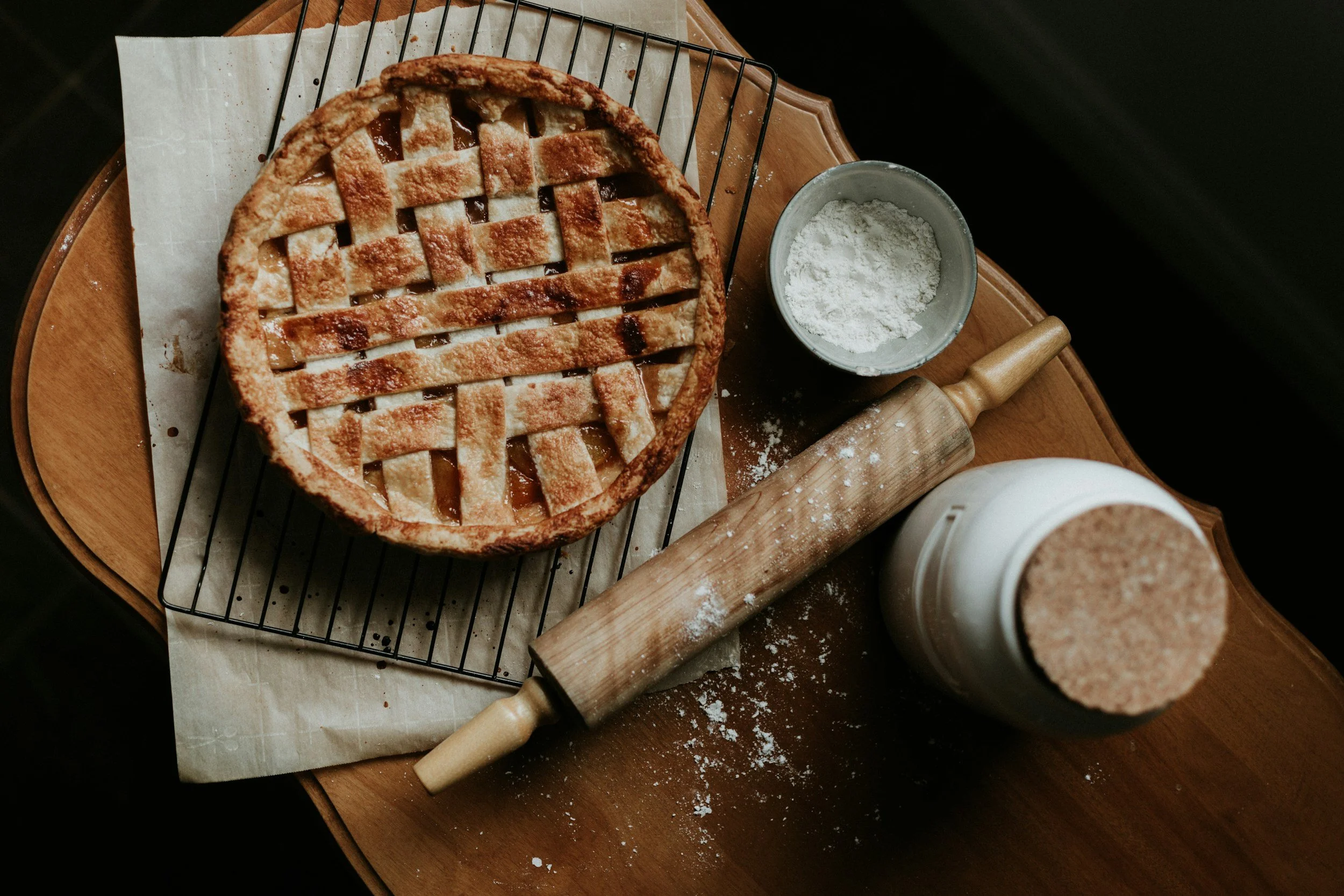
The Science of Butter Pie Crust
Pie dough is one of the clearest demonstrations of an important principle in baking:
Technique can change the finished product even when the ingredients remain almost identical.
Flaky pie dough and mealy pie dough contain the same basic ingredients—pastry flour, butter, cold water, salt, and, optionally, a small amount of sugar.
Yet the two doughs behave differently and produce distinctly different crusts.
Why?
The major difference is how the butter is incorporated into the flour before the water is added.
That one step changes how much flour becomes coated with fat, how readily the flour absorbs water, how much gluten can develop, how steam behaves during baking, and ultimately whether the crust becomes dramatically flaky or exceptionally tender and resistant to moisture.
In our pies, I like to give these two doughs different jobs:
Mealy pie dough is used for the bottom crust, where tenderness and resistance to moisture from the filling are particularly important.
Flaky pie dough is used for the top crust, where we want crispness, visible layers, lift, and beautiful flakiness.
The formulas may look very similar on paper.
The technique makes them completely different pastries.
THE FORMULAS
Flaky Pie Dough
Pastry flour — 500 g
Butter — 350 g
Cold water — up to approximately 150 g
Salt — 10 g
Sugar, optional — 25 g
Mealy Pie Dough
Pastry flour — 500 g
Butter — 325 g
Cold water — up to approximately 125 g
Salt — 10 g
Sugar, optional — 25 g
Important when working with butter: These formulas were originally developed using shortening. Butter contains both fat and water, whereas shortening is essentially all fat. Therefore, when making the formulas with butter, treat the listed water as an approximate maximum rather than automatically adding every gram.
Add enough water to produce a cohesive dough.
The dough determines the final amount of water—not simply the number printed in the formula.
WHY PASTRY FLOUR?
Both doughs begin with pastry flour for a very specific reason.
Pie crust requires enough protein to provide structure so that the dough can be rolled, lifted, shaped, crimped, and baked without falling apart.
But we do not want the amount of gluten development that we would seek in bread.
Bread needs strength and elasticity.
Pie pastry needs tenderness.
Pastry flour provides an excellent balance. Its relatively low protein content limits the potential for excessive gluten development while still providing enough structure to hold the pastry together.
This brings us to one of the most important principles students should understand about pie dough:
Gluten itself is not the enemy. Excessive gluten development is the problem.
Without any gluten structure, we couldn't roll a pie crust.
With too much gluten development, however, the dough becomes elastic, tough, and prone to shrinking.
Our goal is controlled gluten development.
And one of the primary ways we control it is with fat.
WHY BUTTER MAKES SUCH BEAUTIFUL PIE PASTRY
Butter contributes much more than flavor.
It provides tenderness, assists in controlling gluten development, contributes to browning, and—when handled correctly—creates extraordinary flakiness.
Butter is an emulsion containing roughly 80–82% milk fat along with water and milk solids.
That water becomes extremely important when we make flaky pie dough.
As the pie enters the oven, the butter melts and the water contained within the butter turns to steam.
That steam expands.
If we have preserved pieces and flattened sheets of butter within the dough, the expanding steam helps push apart the surrounding layers of pastry.
That is one of the mechanisms that creates a beautifully flaky crust.
But butter can perform another function.
If we work butter much more thoroughly into flour, it coats the flour particles with fat.
That coating reduces the flour's ability to absorb water.
And that gives us an entirely different pastry.
This is the fundamental distinction between flaky dough and mealy dough.
FLAKY PIE DOUGH: PRESERVING THE BUTTER
The defining characteristic of flaky pie dough is simple:
We deliberately leave pieces of butter visible in the dough.
Begin with cold butter.
Combine the pastry flour, salt, and sugar if using.
Add the cold butter and cut or rub it into the flour only until the pieces are approximately pea to hazelnut size.
Then stop.
This is where students frequently make their first mistake.
They see pieces of butter and assume they haven't finished mixing.
But those pieces of butter are exactly what we want.
Visible butter is not unfinished mixing. Visible butter is potential flakiness.
If you continue working the butter until the mixture resembles cornmeal, you have changed the architecture of the dough and moved toward the mealy method.
WHAT HAPPENS TO THOSE PIECES OF BUTTER?
The pieces of butter do not remain round.
When the dough is rolled, the rolling pin compresses them.
A small chunk of cold butter becomes a thin, flattened piece of butter trapped between layers of dough.
That is exactly what we want.
During baking, the butter melts and the water contained within it turns to steam.
Steam expands dramatically when heated.
Because those flattened areas of butter interrupt the continuity of the dough, steam can push the surrounding pastry apart.
The flour and proteins then set around those spaces.
The result is the irregular, delicate layering we recognize as:
FLAKINESS.
This is why temperature control matters so much.
If the butter melts before the pie enters the oven, we lose much of that architecture.
Instead of remaining as discrete pieces within the dough, warm butter smears into the flour.
Once that happens, we cannot simply refrigerate the dough and expect the original butter pieces to magically reappear.
The fat may become firm again, but its distribution has already changed.
COLD BUTTER IS IMPORTANT—BUT PLASTICITY MATTERS TOO
We often tell students simply:
Keep everything cold.
That is good advice, but it is incomplete.
Butter can actually be too cold.
Rock-hard butter may fracture into hard little shards rather than flattening during rolling.
What we really want is butter that is:
Cold, firm, but slightly plastic.
It should resist pressure while still being capable of flattening.
That gives us the best opportunity to create thin pieces of butter throughout the dough.
ADDING WATER TO FLAKY DOUGH
Once the butter has reached the proper size, add the cold water gradually.
Do not automatically dump the entire measured quantity into the bowl.
Begin with most of it and gently toss the mixture.
Then evaluate the dough.
Does it hold together when pressed?
If not, add a little more water.
Continue only until the dough can be gathered together.
The dough should look somewhat rough and shaggy.
It should not look smooth like bread dough.
And it should not be kneaded.
Once water reaches flour, gluten formation can begin. Continued mixing strengthens that gluten network.
Therefore:
Once the water is added, less mixing generally means a more tender crust.
Mix until the dough comes together.
Then stop.
WHY FLAKY DOUGH MAKES A BEAUTIFUL TOP CRUST
A top crust provides an ideal environment for flaky pastry.
Unlike the bottom crust, it is not sitting directly underneath a wet filling.
Instead, its upper surface is exposed directly to the hot oven environment.
As the pie heats, the butter melts, moisture turns to steam, layers separate, and the structure begins to set.
The milk solids in butter also contribute wonderful flavor and browning.
The result is a crisp, richly flavored, visibly flaky top crust.
A solid top crust must also be vented.
Those decorative slashes we cut into a pie are not simply decorative.
The filling underneath the crust is releasing tremendous amounts of steam.
That steam needs somewhere to go.
Proper vents allow steam to escape rather than accumulating underneath the crust and potentially creating large bubbles, separating the crust from the filling, or forcing filling through the edges.
MEALY PIE DOUGH: SAME BUTTER, DIFFERENT MISSION
Now we take essentially the same ingredients and deliberately treat the butter differently.
In mealy pie dough, we do not preserve large pieces of butter.
Instead, the butter is worked much more thoroughly into the flour until the mixture resembles coarse cornmeal.
That is the origin of the term "mealy."
It does not mean the finished crust is unpleasantly dry or grainy.
It describes the appearance of the flour-and-fat mixture before the liquid is added.
For mealy dough, continue working the butter into the flour until the mixture is relatively uniform and the large pieces of butter have disappeared.
That additional mixing is intentional.
We are trying to coat much more of the flour with butter.
WHY COATING THE FLOUR MATTERS
This is the science that makes mealy dough particularly useful for a bottom crust.
Flour needs water to develop gluten.
But fat and water do not readily mix.
When butter coats particles of flour, that fat creates a barrier between portions of the flour and the available water.
As a result, less flour becomes fully hydrated.
Less hydration means less potential gluten development.
The resulting pastry is very tender and short—meaning that instead of pulling or stretching, it breaks cleanly and easily when eaten.
But there is another enormous advantage.
The fat coating also makes it more difficult for moisture from the filling to migrate rapidly into the flour.
That is why mealy dough is particularly useful underneath a wet filling.
WHY I USE MEALY DOUGH FOR THE BOTTOM CRUST
The bottom crust has the most difficult job in the pie.
Think about its environment.
Above it sits a wet filling.
Below it sits a pie pan.
Meanwhile, the top crust is surrounded by hot oven air.
As fruit heats, its cells break down and release juice.
Sugar draws additional moisture from the fruit.
That liquid eventually needs to be thickened by starch or another thickener.
During that process, however, the bottom pastry is sitting directly underneath all of that moisture.
That is where mealy dough has an advantage.
Because more flour has been coated with butter, the pastry is less receptive to water than flaky dough.
It is not waterproof.
No pie dough can compensate for an improperly formulated filling or an underbaked pie.
But mealy dough provides an additional level of protection against moisture absorption.
For students, the easiest way to remember the distinction is:
FLAKY DOUGH = preserve the butter pieces to create layers.
MEALY DOUGH = distribute the butter more thoroughly to create tenderness and moisture resistance.
WHY MEALY DOUGH GENERALLY NEEDS LESS ADDED WATER
Notice that the mealy formula calls for less water than the flaky formula.
That makes sense once we understand the method.
In mealy dough, a greater percentage of the flour has been coated with butter.
That flour cannot absorb water as readily.
Therefore, we generally require less added water to bring the dough together.
And because we are using butter rather than shortening, we have another consideration:
Butter already brings some water into the formula.
For that reason, particularly in the mealy dough, do not force the entire measured quantity of water into the mixture.
Add it gradually.
When the dough holds together when gently compressed, you have enough.
THE SQUEEZE TEST
This is one of the most useful tests students can learn.
Take a small handful of the mixture and squeeze it gently in your palm.
If it holds together when released, there is probably enough moisture.
If it immediately crumbles apart, it may need a little additional water.
This is far more reliable than expecting every batch to require exactly the same amount of water.
Flour absorption changes.
Humidity changes.
Temperature changes.
Different brands and batches of flour behave differently.
Professional bakers learn to read the dough rather than blindly obeying the measuring cup.
DO NOT OVERWORK THE DOUGH AFTER ADDING WATER
Once water has been introduced, flaky and mealy dough share the same rule:
Handle gently and minimally.
We are not kneading.
We are not trying to make the dough elastic.
We are not trying to make it perfectly smooth.
If pie dough becomes springy and repeatedly contracts when you roll it, gluten has become too developed or too tense.
The dough is telling you to stop.
Wrap it.
Refrigerate it.
Let the gluten relax.
WHY PIE DOUGH MUST REST
Once the dough has been mixed, portion it and gently flatten it into a disk.
Do not refrigerate it as a large ball.
A disk cools more evenly and gives us a shape that is already conducive to rolling.
Wrap the dough well and refrigerate it for at least 30-60 minutes
This resting period accomplishes several things.
The butter becomes completely firm again.
Moisture redistributes through the dough.
The flour continues to hydrate.
Most importantly, the gluten relaxes.
A rested dough rolls more easily, requires less force, and is much less likely to spring back.
Resting is not downtime.
Resting is part of the method.
ROLLING THE DOUGH
Remove the dough from the refrigerator and allow it to become just pliable enough to roll.
If the dough cracks into large pieces as soon as the rolling pin touches it, it is probably too cold.
Give it a few minutes.
Lightly flour the work surface and rolling pin.
Begin rolling from the center outward.
Rotate the dough periodically so that it remains round and does not adhere to the work surface.
Avoid aggressively rolling backward and forward over the same area.
And never stretch the dough to make it fit the pan.
If you stretch pie dough into the pan, the dough remembers that tension.
When heated, it attempts to contract.
That is one of the primary causes of pie crust shrinkage.
Instead:
Roll it large enough. Lift it. Lower it gently into the pan. Let it settle naturally into the corners.
Never pull it into place.
WHAT STUDENTS SHOULD SEE BEFORE THE DOUGH IS EVEN BAKED
One of the most valuable parts of making these two doughs side by side is comparing them visually.
Flaky Dough
Before the water is added, visible pieces of butter should remain approximately pea to hazelnut size.
The mixture should look irregular.
After rolling, flattened streaks or patches of butter may still be visible.
That is good.
Those streaks are evidence that the butter has remained separate enough to help produce layers.
Mealy Dough
Before the water is added, the mixture should resemble coarse cornmeal.
Large butter pieces should no longer be obvious.
The mixture should look much more uniform because more of the flour has been coated with butter.
That visual distinction is the heart of this lesson.
WHAT ACTUALLY HAPPENS IN THE OVEN?
Once the pie enters the oven, several transformations begin.
The butter starts to melt.
The water contained in the butter and dough begins turning into steam.
That steam expands.
Starch absorbs available moisture and begins to gelatinize.
Proteins coagulate and help set the structure.
As moisture continues evaporating, the crust becomes progressively drier and crisper.
Finally, the surface browns through a combination of caramelization and Maillard reactions, creating the deep flavor and aroma we associate with properly baked pastry.
But the internal structures of the two doughs are different.
In flaky dough:
Larger and flattened pieces of butter create discontinuous layers within the dough.
As the butter melts and water turns to steam, those areas help separate the surrounding pastry.
The structure sets around those spaces.
The result is flakes and layers.
In mealy dough:
Butter has been dispersed much more thoroughly through the flour.
Instead of producing large distinct layers, the butter primarily coats and tenderizes the flour.
The result is a finer, shorter, more tender structure with improved resistance to moisture.
Same ingredients.
Different fat distribution.
Different internal architecture.
Different finished crust.
That is pastry science.
TROUBLESHOOTING PIE DOUGH
My flaky crust isn't flaky.
The butter was probably worked too finely into the flour, or it became too warm and smeared into the flour.
If your flour-butter mixture resembled cornmeal before adding the water, you were essentially making mealy dough.
Solution: Stop mixing while visible pea- to hazelnut-sized pieces of butter remain and keep the butter cool throughout production.
Butter is leaking out of my crust in the oven.
A small amount of butter movement can occur, but excessive pools of butter usually indicate a problem.
The dough may have become too warm before baking, the butter pieces may have been excessively large, or the pastry structure may not have developed enough to contain the melting fat.
Solution: Keep butter pieces appropriately sized, chill the shaped pastry before baking when necessary, and place the pie into a properly preheated oven.
My crust is tough.
Common causes include too much water, excessive mixing after the water was added, too much flour during rolling, or repeated rerolling.
Solution: Use only the water necessary to bring the dough together and minimize handling after hydration.
My crust shrank.
The dough was probably stretched into the pan, overworked, insufficiently rested, or too warm before baking.
Solution: Never stretch dough to fit the pan. Rest it adequately and chill the shaped crust when appropriate before baking.
My bottom crust is soggy.
Possible causes include an excessively wet filling, insufficient thickener, underbaking, inadequate bottom heat, or allowing the unbaked filling to sit in the crust too long before baking.
Solution: Use mealy dough for added moisture resistance, formulate and thicken the filling correctly, assemble reasonably close to baking time, and bake until the bottom crust—not merely the top—is completely done.
My dough cracks when I roll it.
It is most likely too cold.
Solution: Let refrigerated dough sit briefly until it becomes pliable while remaining cool.
A few small cracks around the perimeter are normal.
My dough is sticky.
The butter may be getting too warm, too much water may have been added, or the room may simply be warm.
Solution: Stop working and refrigerate the dough.
Do not keep throwing flour at a warm dough. Excess flour changes the formula and can produce a dry, tough crust.
My crust is pale.
It may simply need more time in the oven.
Butter crust should develop beautiful golden-brown color.
The milk proteins and sugars naturally present in butter contribute significantly to that browning and flavor.
A pale crust may be technically cooked, but a properly browned crust has considerably more flavor.
ONE FINAL PRINCIPLE: KEEP THE BUTTER COLD
If there is one phrase worth repeating throughout the entire lesson, it is:
Keep the butter cold.
But remember what we actually mean by that.
We are not keeping butter cold simply because a recipe tells us to.
We are protecting the physical structure we deliberately created.
In flaky dough, we are protecting distinct pieces and sheets of butter that will eventually contribute to layers.
In mealy dough, we are protecting the controlled distribution of butter throughout the flour.
If the butter melts prematurely, that carefully created structure changes.
Temperature is therefore not merely an ingredient-management issue.
Temperature is part of the architecture of pastry.
THE LESSON BEHIND THE PIE
Flaky and mealy pie dough demonstrate one of the most important concepts in baking:
Fat distribution controls structure.
Leave butter in larger pieces and those pieces can flatten into layers that separate during baking.
Work butter thoroughly into flour and the fat coats more flour particles, limiting hydration, restricting gluten development, increasing tenderness, and helping protect the pastry from moisture.
Then add only the water the dough actually needs.
Mix minimally.
Rest thoroughly.
Roll without stretching.
Keep the butter cool.
Bake completely.
Once students understand those principles, pie dough stops being something mysterious that either "works" or "doesn't work."
They can begin diagnosing it.
They can look at a bowl of flour and butter and know whether they are headed toward flaky dough or mealy dough.
They can feel a dough and recognize whether it needs another splash of water.
They can see butter beginning to soften and know it is time to stop and chill the dough.
And most importantly, they understand why they are doing each step.
For our two-crust pies, the two doughs work together beautifully:
MEALY DOUGH ON THE BOTTOM
Tender, short, and better equipped to resist moisture from the filling.
FLAKY DOUGH ON THE TOP
Buttery, crisp, layered, and beautifully flaky.
Same basic ingredients.
Different handling.
Different architecture.
Different purpose.
That is the difference between simply following a pie recipe and understanding how pastry works.